
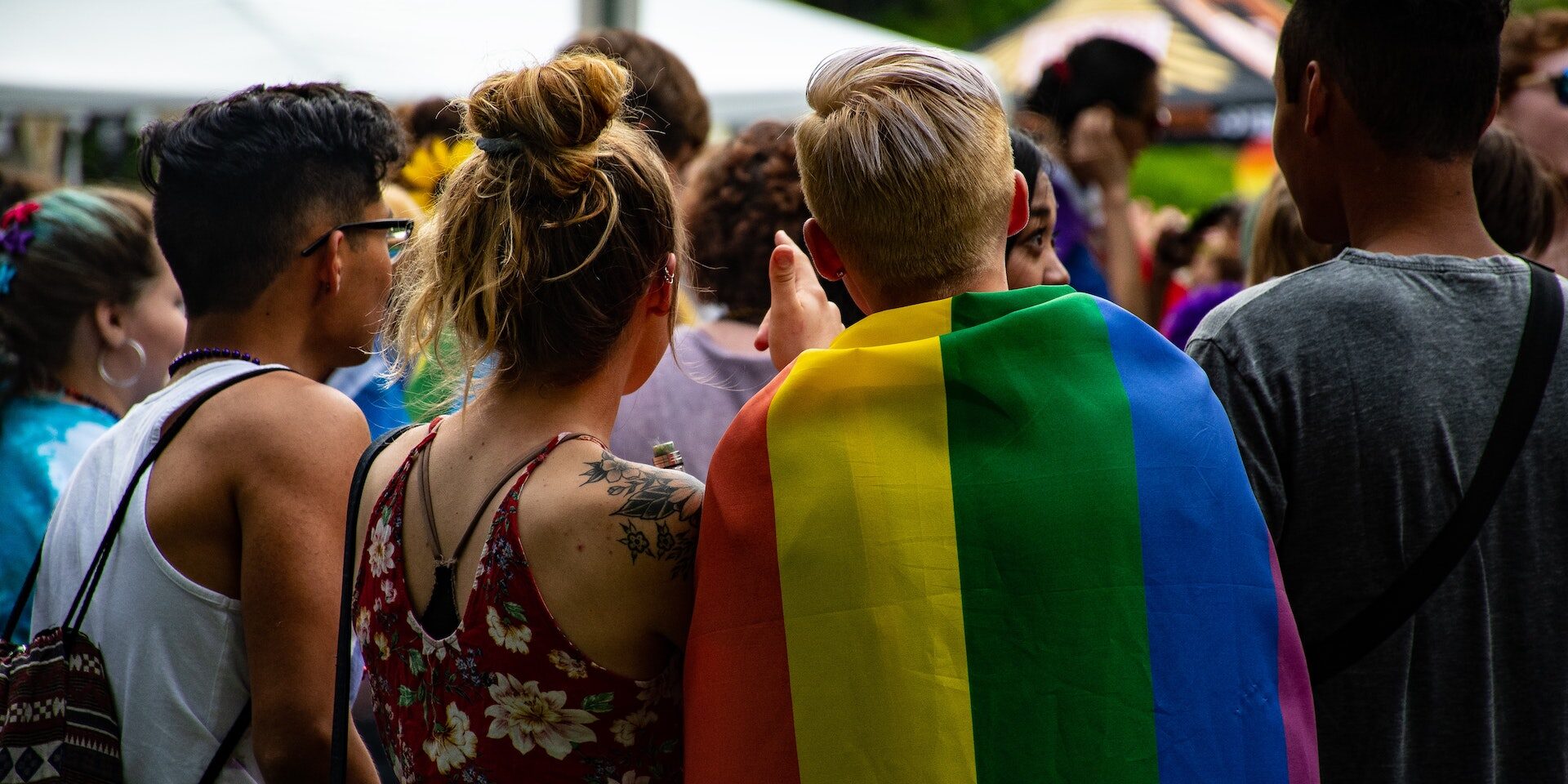
It’s the most wonderful queer time of the year – PRIDE month! For the LGBTQIA+ community, June kicks off the summer with a joyous, celebratory month of parties, parades, and more. Pride month is so many things. It began as a protest march in the early 1970s to mark the anniversary of the Stonewall Inn uprising in 1969. It’s a time to raise awareness and focus on progress. You may also think of it as a time when businesses cash in on our community, both through merchandise pandering and corporate sponsorship of Pride events.
AND. It also can be a time that might feel triggering as hell (no pun intended).
It’s supposed to be all rainbows and marches and dance music, but for some of us it can also be a bit of a tough time. Queer and trans folks who have deconstructed from fundamentalist or high-control religion are at unique risk for feeling triggered during this time. Why is pride month so triggering?
Your Social Media Feeds Aren’t Siloed
Even if we are out, proud, and deconverted, most of us aren’t 100% cut off from everyone in our family and community of origin. That’s usually a good thing. And if that’s you, there’s a good chance that some of those folks are mixed into your social media feeds. If you grew up in a town, community, or clan that was conservative, highly religious, or both, you might encounter some unpleasant Pride-related content when you check your socials.
Cishet conservative folks sometimes reduce LGBTQIA+ identification down to an issue of sex and genitalia. They equate discussing (and celebrating) your own queerness with telling everyone what you do in the bedroom. This concern is, of course, layered with the general puritanical American sentiment toward sex and nudity. Other negative takes include falsely equating LBGTQIA+ folks with pedophiles, and characterizing any gender nonconformity as sinful.
You may know, on one hand, that your existence isn’t inherently any more sexual or sinful than a cishet person’s, that the vast majority of pedophiles are cishet men, and that gender expression is ultimately relative to cultural constructs and trends (see: “founding fathers” donning wigs and heels). These prejudices are exactly why we have and need Pride celebrations.
On the other hand, you may remember what it’s like to think this way, and know just how passionately judgmental folks can be. And no one likes being negatively judged by people who know them. You may successfully avoid thinking about these bigoted opinions for 11 months of the year. But when June hits, and your aunt Susie feels empowered to share her “Love the sinner, hate the sin” hot takes on Facebook, it can be a real shock to the system.
WHAT YOU CAN DO: You could consider a summer break from socials entirely, or at least some of them. If that doesn’t feel realistic, consider temporarily muting your problematic family members, or cleaning out your friends list. Screenshot what you see and vent to your queer friends, especially those who get it.
Your Family Isn’t Celebrating Pride
If you live with your family of origin, or remain in close contact with them, you might feel awkward or defensive about going to Pride events. Your grandma’s judgy looks and comments can be a serious buzzkill when you’re headed out the door to your local Pride parade in your glitter and frills.
Then when you get to said parade, despite the revelry and fun, there are reminders of your religious past and your family’s judgment and/or lack of support. Protesters are there to visually assault you with obnoxious “you’re going to hell” signs. The “Free Mom Hugs” ladies, despite their positivity, serve as a reminder of what you’re not getting back home. Similarly, the PFLAG folks remind you that your family would never be caught dead marching in a Pride parade.
WHAT YOU CAN DO: Queer folks pretty much invented chosen family, so find yours and keep them close. I’m not saying you should bypass and ignore all those big feelings about your bio fam, but community is an extremely helpful salve. You can talk to your therapist about the disappointment, sadness, embarrassment, anger, and other big feelings you rightfully feel. Or vent it out in your journal.
You’re Not Sure You’re LGBTQIA+ Enough
I recently wrote about how half of all LGBTQIA+ folks in the US claim B for bisexual. And yet, despite their dominance in the numbers, bisexual folks are usually the most likely to feel like they don’t belong in queer communities. It might be because they recognize their privilege if they’re partnered in what appears (to most people) to be a heterosexual relationship.
People of all genders and orientations who aren’t fully out, or who are questioning, can also feel like they don’t qualify to participate in Pride festivities.
First of all, you don’t even have to be LGBTQIA+, because cishet allies are allowed to participate in Pride! We love true allies, and we need them! As long as everyone is respectful and recognizes that events and spaces are oriented to queer and trans folks first, allies can join the party/protest/parade.
But more importantly, dear reader, if you are anything besides 100% heterosexual and 100% cisgender, you’re officially part of the community. You are queer enough. End of story. Come join the party!
WHAT YOU CAN DO: Show up! Find the event(s) that feel the least intimidating, grab a supportive friend, and get out there. Yes, you might feel anxious and weird. Feel the fear and do it anyway. If the event sucks, you can leave. But it will probably be a lot better than you fear.
You’re Not Sure Where You Belong
A couple of decades ago, during Pride weekend, you might have found me out late drinking and dancing in a nightclub (even if I wasn’t 100% out). One decade ago, you’d have seen me marching in the parade, smiling and waving at the watchers. Nowadays, Im more likely to be found next to my wife watching the parade from camping chairs, or wandering around the Pride festival with my teen.
If you think of Pride as just a bunch of wild parties, think again. There are so many ways to participate and celebrate, like volunteering, organizing, attending arts performances or niche community gatherings (like BIPOC parties, trans meet ups, senior activities), participating in rallies and protests, or playing in sports or game tournaments. Here in San Diego, we have a Pride 5k!
WHAT YOU CAN DO: Dig a little deeper to find out what Pride events and activities are happening in your area. Do an online search, ask your queer friends, or follow LGBTQIA+ social media accounts that are local to your area.
Your Old Conditioning Shows Up
You may have been indoctrinated for years and years with the belief that it was wrong/sinful/evil to be your queer or trans self, if you were a part of a fundamentalist or high-control religion. That harmful view may have been instilled in you since birth. If you saw yourself that way for years and years – even decades – a simple intellectual shift may not have undone all the stress to your nervous system.
Queer folks with religious trauma may have lingering effects like irrational fears of hell or being “left behind” in endtimes. You may have a tiny part of you that questions whether all of this “being authentically you” and “listening to your gut” stuff is just nonsense. You may feel physical anxiety symptoms when you see fundie protesters because you, at one time, were one of them, or at least knew people who were.
WHAT YOU CAN DO: Practice calming and grounding techniques when your nervous system gets activated. Check out this calm place exercise, or practice the 5 Senses grounding technique.
Are you interested in diving deeper on these issues? Schedule a consult call today.